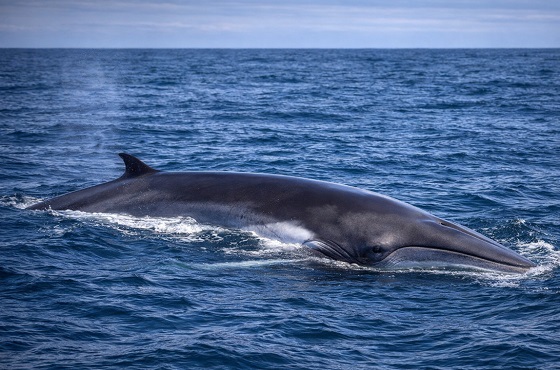
Fin Whale
The fin whale is a sleek and powerful baleen whale known for being the second largest animal on Earth, surpassed only by the blue whale. These massive marine mammals inhabit oceans across the globe and are admired for their speed, graceful movement, and remarkable feeding abilities.
-
- Where do fin whales live?
-
- Why are fin whales important to ocean ecosystems?
Below you’ll find clear answers to these questions, along with useful information about the fin whale’s size, behavior, feeding habits, and ecological importance.
Balaenoptera physalus
The fin whale is a species of baleen whale belonging to the rorqual family, which also includes blue whales, humpback whales, and minke whales. These whales are known for their streamlined bodies and incredible swimming speed. Because of their long, slender shape and swift movement through the water, fin whales are sometimes called the
“greyhounds of the sea.”
Quick Facts
-
- Type: Marine mammal (baleen whale)
-
- Diet: Carnivore (filter feeder)
-
- Habitat: Oceans worldwide
-
- Length: Up to 85 feet (26 meters)
-
- Lifespan: Around 70–90 years
-
- Conservation status: Vulnerable
Overview
Fin whales are found in all the world’s major oceans, from polar waters to temperate seas. They typically prefer deep offshore waters but may occasionally appear near coastlines when food is abundant. Their massive size and streamlined shape allow them to travel long distances during seasonal migrations between feeding and breeding areas.
These whales are known for their distinctive body shape. They have a narrow, pointed head and a tall dorsal fin located far back on the body. Their coloration is usually dark gray to brownish on the back with a lighter underside, which helps them blend into the ocean environment.
Physical Characteristics
Fin whales are extremely large animals, second only to the blue whale in size. Despite their massive bodies, they are surprisingly fast swimmers and can reach speeds of more than 20 miles per hour.
-
- Long, slender body designed for efficient swimming
-
- Distinct dorsal fin located toward the back of the body
-
- Asymmetrical coloring on the lower jaw (one side darker than the other)
-
- Rows of baleen plates used for filter feeding
-
- Smooth skin that helps reduce drag in the water
Diet and Feeding Behavior
Fin whales are filter feeders, meaning they consume large amounts of tiny marine organisms by filtering seawater through baleen plates in their mouths. They feed by taking in huge gulps of water filled with prey and then pushing the water out while trapping food inside.
-
- Small schooling fish such as herring and capelin
-
- Plankton and small crustaceans
During feeding seasons in colder waters, fin whales may consume several tons of food per day. Their feeding technique, known as
lunge feeding, involves accelerating rapidly toward dense groups of prey with their mouths wide open.
Behavior and Migration
Fin whales are known for their long seasonal migrations. In many regions, they travel to colder polar waters during the summer months where food is abundant. During winter, they migrate to warmer waters where breeding and calving occur.
Unlike some whale species that travel in large groups, fin whales are often seen alone or in small groups. However, they may gather in larger numbers in areas with abundant food supplies.
Ecological Importance
Fin whales play an important role in maintaining healthy marine ecosystems. By feeding on large quantities of krill and small fish, they help regulate marine food webs. In addition, whales contribute to nutrient cycling in the ocean through a process sometimes called the
“whale pump.”
When whales surface and release waste, nutrients are returned to the upper ocean layers where they support plankton growth. This plankton forms the base of the marine food chain and even helps absorb carbon dioxide from the atmosphere.
Interesting Features of the Fin Whale
-
- Second largest animal: Only the blue whale grows larger.
-
- Fast swimmer: Fin whales are among the fastest large whales.
-
- Unique jaw coloring: One side of the lower jaw is lighter than the other.
-
- Powerful feeding strategy: Their lunge feeding allows them to capture huge volumes of prey.
-
- Long-distance travelers: Fin whales migrate thousands of miles each year.
FAQ
How big do fin whales get?
Fin whales can reach lengths of about 85 feet and weigh up to 80 tons, making them the second largest animals on Earth.
What do fin whales eat?
They mainly feed on krill, small fish, plankton, and other tiny marine organisms using baleen plates to filter food from seawater.
Where can fin whales be found?
Fin whales live in oceans around the world, from polar waters to temperate seas, and often migrate long distances between feeding and breeding grounds.
References (General)
-
- NOAA Fisheries — marine mammal information
-
- IUCN Red List — conservation status reference
-
- National Geographic — whale species overview
Animals > Animals Starting with F