Humboldt Penguin
The Humboldt penguin is a cold-water specialist living along South America’s Pacific coast. Powered by the nutrient-rich Humboldt Current, these penguins thrive in a surprisingly dry, desert-like shoreline—where chilly seas, rocky islands, and coastal caves create ideal conditions for feeding and nesting.
-
- Where do Humboldt penguins live?
-
- What do Humboldt penguins eat?
-
- Why are Humboldt penguins threatened?
Below you’ll find clear answers to all of these—plus practical ecology, behavior, and conservation notes.
Spheniscus humboldti
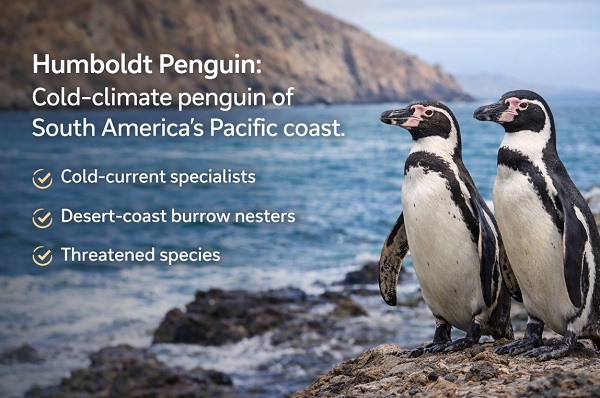
Humboldt penguins are medium-sized penguins famous for their black-and-white “tuxedo” pattern, rosy bare skin at the base of the bill, and their strong link to one of the world’s most productive marine ecosystems. Unlike Antarctic species that live on ice, Humboldt penguins are coastal birds that nest on rocky shores and guano-rich islands—often within sight of sandy deserts. Their story is a powerful example of how ocean currents shape life on land.
Quick Facts
-
- Diet: Carnivore (mainly fish)
-
- Habitat: South America’s Pacific coast (cold, upwelling waters)
-
- Typical lifespan: Often 10–15 years in the wild (can be longer in managed care)
-
- Conservation status: Threatened (status varies by assessments; generally considered at risk)
Overview
The Humboldt penguin is named after the Humboldt Current, a cold ocean current that runs northward along the coasts of Chile and Peru. This current drives upwelling—bringing nutrients from deep water to the surface—fueling huge blooms of plankton and supporting dense schools of fish. For penguins, that means reliable hunting close to shore.
What makes Humboldt penguins especially interesting is the contrast between ocean and land: they forage in cold seas, yet nest on coasts that can be dry, windy, and exposed to intense sun. To cope, they rely on shaded crevices, caves, and burrows—often dug into guano deposits—or they use natural gaps among rocks. This nesting strategy helps protect eggs and chicks from heat stress and predators.
Physical Characteristics
Humboldt penguins have a classic penguin silhouette with strong flippers for swimming and a streamlined body for chasing fish. Their coloring is more than style: the dark back helps camouflage them from above in the ocean, while the white belly makes them harder to spot from below against bright surface light.
-
- Medium-sized penguin with a bold black chest band
-
- White face stripe that curves around the eye and down the neck
-
- Pink bare skin at the base of the bill (can help with heat release)
-
- Dense, waterproof feathers that insulate in cold water
Habitat and Range
Humboldt penguins live along the Pacific coasts of
Peru and Chile, especially around offshore islands and rocky headlands. Many colonies are associated with areas historically rich in guano (accumulated seabird droppings), which can create soft ground for burrowing and provide shaded nesting cavities. Their distribution closely follows zones where the Humboldt Current keeps waters cool and food abundant.
Because they depend on nearshore prey, Humboldt penguins typically don’t roam as far as some other penguin species. When conditions are good, adults can feed efficiently and return quickly to relieve a partner on the nest. When conditions worsen—such as during strong El Niño events—food becomes scarce or shifts location, forcing longer trips and reducing breeding success.
Diet and Hunting Behavior
Humboldt penguins are fast, agile swimmers that hunt mainly small schooling fish. They pursue prey underwater using powerful flipper strokes and sharp turns, often feeding in productive zones created by upwelling. Their success depends on timing: when fish schools are close to shore, adults can feed themselves and still bring meals to chicks regularly.
-
- Main foods: small fish (commonly anchovy- and sardine-type fish), plus squid and crustaceans
-
- Foraging style: pursuit diving and chasing prey underwater
-
- Feeding challenge: food availability can swing dramatically with ocean conditions
Behavior and Social Life
Humboldt penguins are social birds that live and breed in colonies. On land, they communicate with braying calls and body postures. In crowded nesting sites, recognizing a mate and finding the correct burrow matters—a lot. Pair bonds can be strong, and many pairs show site fidelity, returning to the same nesting area across seasons when conditions allow.
Unlike ice-bound penguins, Humboldts must manage heat and dehydration risks. They often rest in the shade, use burrows to keep cool, and may become more active at dawn and dusk. In hot conditions, they can pant and extend flippers to shed heat—simple behaviors that can make the difference between a successful nesting season and failure.
Breeding and Nesting
Breeding timing varies by location and food availability, but the nesting strategy is consistent: find shelter from sun and predators. Humboldt penguins commonly lay two eggs and share incubation duties. When chicks hatch, parents alternate between guarding and foraging. Chicks rely on frequent meals of partially digested fish delivered by adults.
-
- Nest sites: burrows in guano, rock crevices, caves, or under vegetation
-
- Typical clutch: usually two eggs
-
- Parenting: both parents incubate and feed chicks
Threats and Conservation
Humboldt penguins face a mix of natural and human-driven challenges. Their biggest vulnerability is how closely their survival is tied to nearshore fish abundance. When fisheries target the same prey species or when warming events reduce upwelling, penguins may struggle to find enough food—especially during breeding.
On land, nesting colonies can be disturbed by human activity, introduced predators, and habitat changes. Historically, guano extraction altered nesting areas on some islands. Today, conservation efforts focus on protecting colonies, managing fisheries sustainably, reducing disturbance, and controlling invasive predators in critical breeding zones.
Interesting Features (Explained)
-
- Cold-current specialists: They thrive because the Humboldt Current drives nutrient upwelling, creating abundant prey close to shore.
-
- Desert-coast penguins: They can nest near some of the driest landscapes on Earth, relying on burrows and shade to avoid overheating.
-
- Built-in “tuxedo” camouflage: Dark backs and light bellies help hide them from predators and prey underwater.
-
- Heat-management skin patches: The pink bare skin around the face can help release heat when temperatures rise.
-
- Burrow nesting advantage: Nests in guano or crevices stabilize temperature, reduce sun exposure, and offer protection from many predators.
-
- Highly sensitive to El Niño: Warm-water events can push fish deeper or farther away, making feeding trips longer and breeding less successful.
FAQ
Where do Humboldt penguins live?
They live along the Pacific coasts of
Peru and Chile, especially on offshore islands and rocky coastal areas influenced by the cold Humboldt Current.
What do Humboldt penguins eat?
They mainly eat small schooling fish (often anchovy- and sardine-type fish), and they also take squid and crustaceans when available.
Why are Humboldt penguins threatened?
Major threats include reduced prey availability (linked to overfishing and changing ocean conditions such as El Niño), disturbance at nesting sites, and introduced predators in some areas.
References (General)
-
- Britannica — general species background
-
- IUCN Red List — conservation status reference
-
- National Geographic — penguin and coastal wildlife overviews
Animals > Animals Starting with H