

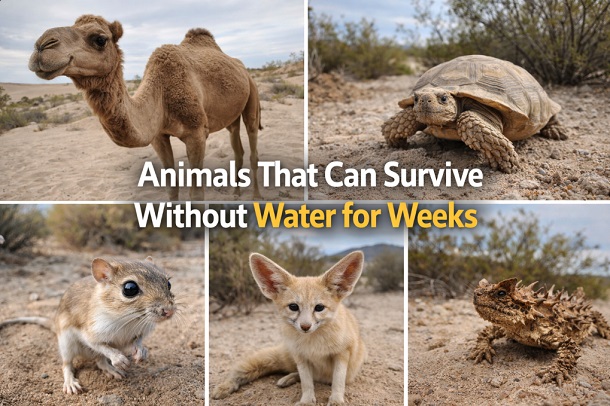
Animals That Can Survive Without Water for Weeks
Water is essential for life. Most animals need to drink regularly to survive, especially in hot and dry environments. However, some remarkable species have evolved the ability to survive without direct access to water for weeks—or even months. These animals rely on special adaptations that allow them to conserve moisture, extract water from food, or tolerate dehydration.
Here are some of the most impressive animals that can survive without water for extended periods.
How Do Animals Survive Without Water?
Before looking at specific species, it’s important to understand the strategies that make this possible. Animals that live in deserts or arid environments typically survive using one or more of these adaptations:
- Metabolic water production: Extracting water from food during digestion.
- Efficient kidneys: Producing highly concentrated urine to reduce water loss.
- Minimal sweating: Reducing evaporation through the skin.
- Nocturnal behavior: Avoiding daytime heat to conserve moisture.
- Fat storage: Using fat reserves that release water when metabolized.
With these strategies in mind, let’s explore some extreme survivors.
1. Kangaroo Rat
The kangaroo rat is one of the most famous desert survivors. Native to North American deserts, this small rodent may never drink liquid water in its entire life.
- Obtains water from dry seeds.
- Produces extremely concentrated urine.
- Remains underground during the day.
Its body is so efficient at conserving moisture that it can survive indefinitely without drinking.
2. Camel
Camels are iconic desert animals known for enduring long periods without water. While they can drink large amounts when available, they can survive up to several weeks in dry conditions.
- Store fat (not water) in their humps.
- Tolerate significant dehydration.
- Have oval-shaped red blood cells that function during dehydration.
Camels can lose up to 25% of their body weight in water—levels that would be fatal for most animals.
3. Desert Tortoise
The desert tortoise survives in extremely dry environments by storing water in its bladder. During rare rainfalls, it drinks deeply and stores the water for later use.
- Can survive months without fresh water.
- Reduces activity during extreme heat.
- Reabsorbs stored water when needed.
This strategy allows it to thrive in some of the harshest desert climates.
4. Thorny Devil (Australian Spiny Lizard)
The thorny devil has an unusual adaptation: it collects water through its skin.
- Skin channels guide water directly to its mouth.
- Absorbs moisture from damp sand and dew.
- Minimizes water loss through behavior.
This clever reptile survives long dry spells using even tiny amounts of environmental moisture.
5. Giraffe
Although giraffes live in savanna regions, they can survive for weeks without drinking water. They get much of their hydration from leaves and plants.
- Extract water from acacia leaves.
- Rarely need to drink daily.
- Conserve moisture through efficient digestion.
This reduces their need to approach watering holes, where predators often wait.
6. Fennec Fox
The small desert-dwelling fennec fox survives in the Sahara with minimal water intake.
- Gets moisture from insects and plants.
- Has large ears that help regulate body temperature.
- Produces concentrated urine.
Its nocturnal lifestyle also helps avoid heat-related water loss.
7. Addax Antelope
The critically endangered addax antelope is another desert specialist.
- Rarely drinks water.
- Survives on moisture from desert vegetation.
- Remains inactive during the hottest hours.
This antelope is highly adapted to life in extreme desert conditions.
8. Tardigrade (Water Bear)
Although microscopic, the tardigrade is perhaps the ultimate survivor. It can enter a dehydrated state called cryptobiosis.
- Loses almost all body water.
- Shuts down metabolism.
- Can survive years in dry conditions.
Once rehydrated, it returns to normal activity.
9. Desert Spadefoot Toad
This amphibian buries itself underground during dry seasons.
- Enters dormancy (aestivation).
- Slows metabolism dramatically.
- Emerges only after rainfall.
This allows it to survive extended drought periods.
Why These Adaptations Matter
Animals that survive without water for weeks have evolved in some of the harshest environments on Earth. Their survival strategies demonstrate how life adapts to extreme scarcity.
Key survival themes include:
- Efficient water recycling
- Metabolic flexibility
- Behavioral adaptation
- Physiological tolerance to dehydration
Without these adaptations, survival in desert ecosystems would be impossible.
Final Thoughts
While most animals depend on regular access to fresh water, some species have developed extraordinary abilities to endure long dry periods. From the tiny kangaroo rat to the towering camel, these animals represent nature’s most efficient water conservers.
In environments where water is scarce and unpredictable, survival depends not on abundance—but on adaptation.


