

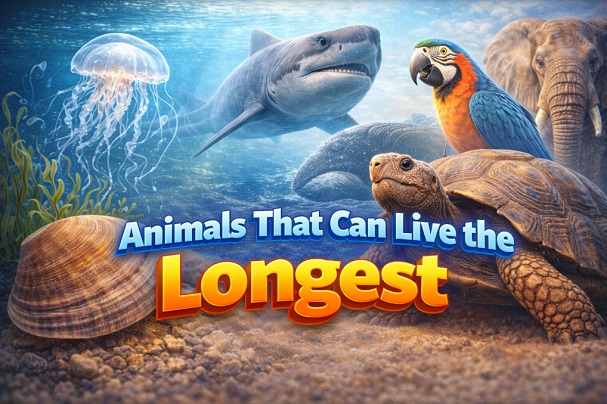
Animals That Can Live the Longest
When we think about long life, humans often come to mind. However, many animals far surpass the human lifespan. Some species can live for centuries, while others seem to slow aging almost entirely. Longevity in the animal kingdom depends on genetics, environment, metabolism, and evolutionary adaptations.
Here are some of the animals that can live the longest, ranked by their maximum recorded or estimated lifespans.
1. Immortal Jellyfish (Turritopsis dohrnii)
The immortal jellyfish is one of the most fascinating organisms on Earth. It has the unique ability to revert its cells back to an earlier life stage.
- Can transform from adult back to juvenile form
- Potentially avoids natural death
- Still vulnerable to predators and disease
While not truly immortal in the practical sense, it can theoretically repeat its life cycle indefinitely under ideal conditions.
2. Ocean Quahog Clam
The ocean quahog clam holds the record for one of the longest confirmed lifespans among animals.
- Can live over 500 years
- One specimen (“Ming”) lived 507 years
- Slow metabolism contributes to longevity
These clams grow slowly in cold, deep waters, which likely helps reduce cellular damage over time.
3. Greenland Shark
The Greenland shark is one of the longest-living vertebrates.
- Estimated lifespan: 250–400 years
- Extremely slow growth rate
- Cold Arctic habitat
Scientists estimate their age by examining eye tissue proteins. Their slow metabolism may be key to their long life.
4. Bowhead Whale
Bowhead whales are the longest-living mammals known.
- Lifespan over 200 years
- Thick blubber for Arctic survival
- Low rates of age-related disease
Some individuals have been found with harpoon fragments dating back more than a century, confirming their remarkable longevity.
5. Giant Tortoise
Giant tortoises are famous for their long lives.
- Can live 100–200+ years
- Slow metabolism
- Low predation as adults
One well-known tortoise, Jonathan, is over 190 years old and still living.
6. Rougheye Rockfish
This deep-sea fish species is another long-lived marine animal.
- Can live over 200 years
- Slow-growing species
- Cold ocean habitats
Deep-sea environments often promote slower aging due to reduced metabolic stress.
7. Red Sea Urchin
Red sea urchins are surprisingly long-lived.
- Lifespan over 100 years
- Show minimal signs of aging
- Continuous growth throughout life
Scientists are particularly interested in their resistance to age-related decline.
8. Koi Fish
Koi fish are known for their longevity in controlled environments.
- Some individuals live over 200 years
- Require excellent care and stable conditions
One famous koi reportedly lived 226 years, although verification methods vary.
9. Elephant
Elephants are among the longest-living land mammals.
- Can live 60–70 years in the wild
- Strong social bonds
- Low natural predation as adults
Their complex brains and large body size may contribute to longer lifespans.
10. Macaw
Some macaw species have impressive lifespans.
- Can live 60–80 years
- High intelligence
- Long-term pair bonding
In captivity with proper care, some parrots live even longer.
Why Do Some Animals Live So Long?
Longevity often depends on a combination of factors:
- Slow metabolism: Reduces cellular wear and tear.
- Cold environments: Slow biological processes.
- Low predation risk: Fewer external threats.
- Genetic adaptations: Enhanced DNA repair mechanisms.
Animals that grow slowly and reproduce later in life often evolve longer lifespans.
Do Larger Animals Live Longer?
There is some correlation between body size and lifespan, but it is not universal. For example:
- Whales and elephants live long lives.
- Small animals like clams and jellyfish can live even longer.
Ultimately, lifespan depends more on evolutionary strategy than size alone.
Final Thoughts
From the potentially immortal jellyfish to centuries-old sharks and clams, the animal kingdom showcases extraordinary examples of longevity. While humans can live over 100 years, many species far exceed that mark.
Understanding how these animals live so long helps scientists study aging, disease prevention, and cellular repair. Nature continues to provide powerful lessons about resilience and the biology of time itself.


