

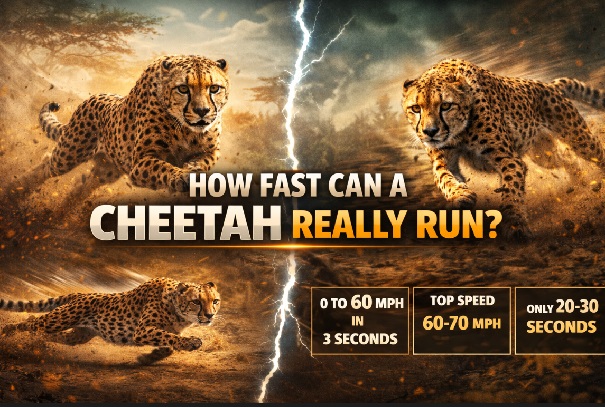
How Fast Can a Cheetah Really Run?
The cheetah is widely known as the fastest land animal on Earth. Images of this slender, spotted predator sprinting across the African savanna have captured human imagination for decades. But how fast can a cheetah really run? The answer is both impressive and more nuanced than many people think. While top speeds are extraordinary, they can only be maintained for short bursts under specific conditions.
Understanding the cheetah’s true speed requires looking at biology, physics, and environmental factors that influence its performance.
The Top Speed of a Cheetah
Under ideal conditions, a cheetah can reach speeds of 60 to 70 miles per hour (96 to 112 kilometers per hour). Some studies suggest brief bursts may approach 75 mph, but these are rare and difficult to measure accurately in the wild.
Key facts about cheetah speed:
- They can accelerate from 0 to 60 mph in about 3 seconds.
- They reach maximum speed in just a few strides.
- Top speed can only be sustained for 20–30 seconds.
- A typical chase covers about 200–300 meters.
This combination of explosive acceleration and short endurance makes the cheetah a specialized sprinter rather than a long-distance runner.
Built for Speed: Unique Physical Adaptations
The cheetah’s body is a masterpiece of evolutionary engineering. Nearly every anatomical feature contributes to maximizing speed.
Major speed adaptations include:
- Lightweight body structure to reduce drag and increase agility.
- Long, flexible spine that acts like a spring, extending stride length.
- Large nasal passages and lungs for increased oxygen intake.
- Oversized heart to pump oxygen-rich blood rapidly.
- Semi-retractable claws that function like track spikes for traction.
- Long tail used for balance and sharp directional changes.
When running at full speed, a cheetah’s stride can measure up to 7 meters (23 feet). During each stride, all four paws leave the ground twice — a phenomenon known as double suspension gallop.
Acceleration: The Real Advantage
While the cheetah’s top speed is impressive, its acceleration is even more remarkable. It accelerates faster than most sports cars over short distances.
Why acceleration matters:
- Prey such as gazelles are highly agile and alert.
- A rapid burst reduces the prey’s reaction time.
- Short chases conserve energy in hot environments.
Unlike marathon predators such as wolves, cheetahs rely on surprise and explosive force rather than endurance.
Environmental Limitations
Despite their incredible speed, cheetahs cannot run at maximum velocity whenever they want. Several environmental and physical limitations affect their performance.
Factors that limit speed include:
- High temperatures, which increase risk of overheating.
- Uneven terrain that may reduce traction.
- Injury risk from stepping in holes or colliding with obstacles.
- Energy depletion after repeated failed hunts.
Because sprinting generates extreme body heat, cheetahs must rest after a chase — successful or not. If a hunt fails, they may need significant recovery time before attempting another.
Speed Compared to Other Animals
Although the cheetah holds the title of fastest land animal, several animals come close in short bursts.
Speed comparison examples:
- Cheetah: 60–70 mph (96–112 km/h)
- Pronghorn antelope: 55 mph (88 km/h)
- Lion: 50 mph (80 km/h)
- Greyhound dog: 45 mph (72 km/h)
Interestingly, pronghorn antelopes can sustain high speeds longer than cheetahs, which suggests evolutionary adaptation to outrun ancient predators.
Hunting Strategy and Success Rate
Speed alone does not guarantee success. In fact, cheetahs only succeed in about 50–60% of their hunts, depending on conditions.
The hunting process typically involves:
- Scanning from elevated positions like termite mounds.
- Careful stalking to reduce detection.
- A rapid sprint when within 60–100 meters of prey.
- Tripping the prey using a swipe of the paw.
After a successful hunt, the cheetah must eat quickly. Larger predators like lions or hyenas may steal the kill.
Why Cheetahs Cannot Run Long Distances
Unlike endurance runners, cheetahs are built purely for speed. Their slender frame and reduced body fat improve aerodynamics but limit stamina.
Endurance limitations include:
- Rapid lactic acid buildup in muscles.
- Extreme oxygen demand during sprints.
- Risk of overheating within seconds.
If forced into prolonged running, a cheetah could collapse from exhaustion. Therefore, hunts are short and calculated.
Speed in Captivity vs. Wild
Cheetahs in captivity rarely reach maximum speed. Limited space and lack of hunting necessity reduce sprint opportunities. In the wild, natural terrain and prey behavior trigger their full athletic potential.
Modern GPS tracking collars have provided more accurate measurements of real-world speeds. Interestingly, many wild chases average closer to 50–60 mph rather than the theoretical maximum of 70 mph.
Final Perspective
So how fast can a cheetah really run? In ideal conditions, up to 70 miles per hour — making it the undisputed fastest land animal. However, this speed is only sustainable for short bursts lasting less than half a minute. The cheetah’s true advantage lies not just in raw speed but in explosive acceleration, precision, and perfectly timed attacks.
Nature has shaped the cheetah into a specialized sprinter, sacrificing endurance for unmatched velocity. Its speed is not just impressive — it is a finely tuned survival strategy designed for life on the open savanna.
Frequently Asked Questions
1. What is the fastest speed ever recorded for a cheetah?
Most reliable measurements place top speed between 60 and 70 mph (96–112 km/h), though brief bursts may slightly exceed this under ideal conditions.
2. How long can a cheetah maintain top speed?
A cheetah can sustain maximum speed for about 20 to 30 seconds before overheating or exhausting its muscles.
3. Are cheetahs faster than all other land animals?
Yes. The cheetah is currently recognized as the fastest land animal, though some species like the pronghorn antelope can maintain high speeds for longer distances.


